A few years ago, a 60-second video meant calendars, crews, reshoots, delays, and approvals that never seemed to end.
But with AI video production, it means a prompt.
And that shift, driven by generative AI in marketing, is quietly rewriting how modern marketing works because video is no longer optional; it’s the backbone of modern marketing.
In fact, 89% of businesses now use video as a marketing tool, and it accounts for up to 82% of all web traffic.
(Source: Marketing LTB)
But the real disruption isn’t video itself, it’s how fast it can now be made.
The Shift: From Weeks to Minutes
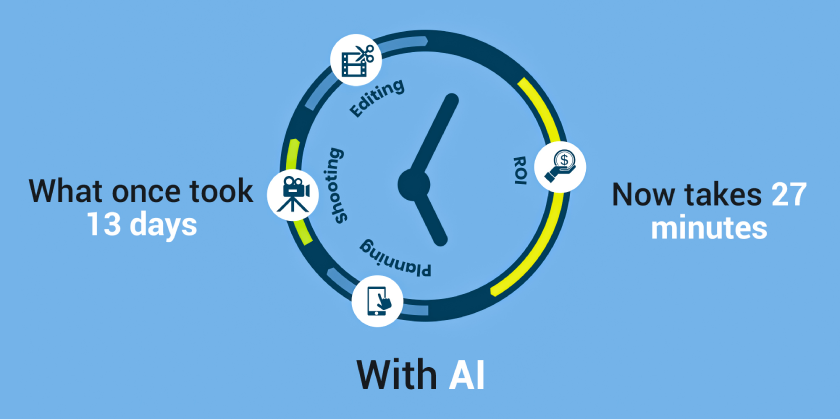
There was a time when one campaign meant weeks of planning, shooting, editing, re-editing, and waiting.
Now, a 60-second video that once took 13 days can be produced in just 27 minutes using AI video production tools.
(Source: Ngram)
And it’s not experimental anymore, 75% of marketers are already using AI in video production workflows.
(Source: Twinstrata)
The industry didn’t evolve; it collapsed its own timeline.
How Brands Are Adapting
Then came the moment brands stopped treating AI like a tool and started treating it like a creative engine. With the rise of AI in brand video production, companies are now rethinking how content is created, scaled, and delivered.
Here are two widely recognized examples.

Cadbury
In its “Not Just a Cadbury Ad,” Cadbury did it first in a way that felt almost unreal.
Cadbury used AI to recreate Shah Rukh Khan’s voice and face, generating thousands of localized versions of one ad. Each small business got a personalized endorsement without reshoots.
Instead of one celebrity ad, they built a system that could adapt endlessly, and they successfully scaled one idea into mass personalization while giving visibility to local stores.
This is a perfect example of how AI Video Production enables mass personalization at scale.

Netflix
Netflix has been quietly integrating AI into parts of its creative pipeline not as a replacement, but as an accelerator.
In one of its projects, The Eternaut, AI has been used to assist with complex visual elements, helping generate environments, enhance scenes, and speed up production-heavy sequences that would otherwise take significantly longer.
This allows teams to experiment faster, iterate visuals quickly, and bring ambitious ideas to life without being limited by time or cost constraints.
The result isn’t “AI-made content,” it’s human storytelling powered by AI Video Production systems.
When a storytelling giant experiments with AI visuals, it signals one thing: This is no longer future tech, it’s infrastructure.
How AI in Brand Video Production Actually Works (Behind the Scenes)
To understand why AI is so effective, it’s important to look at what’s happening behind the scenes.
AI in video production is not just one tool; it’s a combination of systems working together across the content pipeline:
- Script Generation: AI tools can generate initial scripts, hooks, and variations based on prompts and brand guidelines.
- Visual Creation: Generative models can create scenes, backgrounds, and even human-like avatars without physical shoots.
- Voice Synthesis: AI can replicate voices or generate natural-sounding narration in multiple languages.
- Editing Automation: AI-assisted editing tools can cut footage, add transitions, and optimize pacing automatically.
- Content Versioning: One video can be turned into multiple formats for different platforms (YouTube, Instagram, TikTok, etc.).
This layered system reduces dependency on traditional bottlenecks like location shoots, large crews, and long editing cycles.
Instead of replacing creativity, AI removes repetitive tasks, allowing teams to focus on storytelling, strategy, and creative direction.
Why AI Works: The 4 Real Drivers
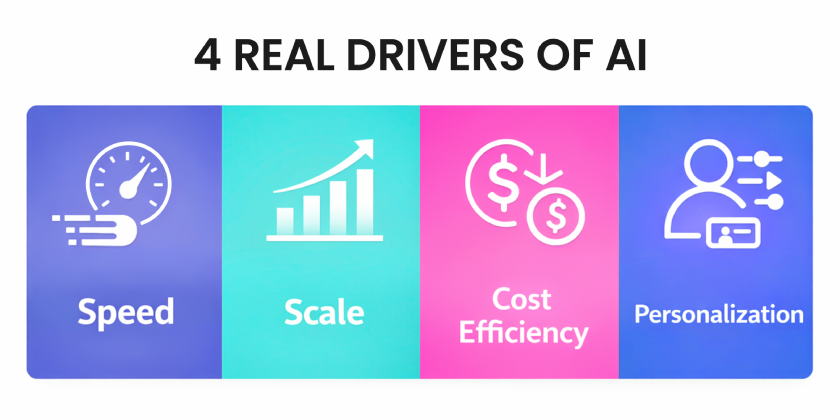
Across all these brands, the same four patterns emerge:
1. Speed
- From weeks to minutes
- Faster campaign launches
2. Scale
- One video and dozens of variations
- Thousands of videos for e-commerce
3. Cost Efficiency
- Massive reduction in production budgets
- Lower barrier to experimentation
4. Personalization
- Different versions for different audiences
- Localized, platform-specific content
The Real Shift: From Production to Systems
The biggest change isn’t just faster editing.
It’s this: Video production is no longer a one-time process; it’s a scalable system.
- AI generates first drafts
- Humans refine and direct
- Content is repurposed across platforms
In fact, 71% of creators now use AI for first drafts and then refine manually. (Vivideo)
So, the role of creators didn’t disappear; it moved upward: From execution to taste-making.

How Artxfilms Is Advancing Video Production with AI Technology
Most production houses are still focused on delivering one final video at a time.
Artxfilms works differently, shifting the focus from single outputs to continuous content flow through AI-powered content creation.
The approach is simple but powerful:
- AI storyboarding to accelerate and refine ideas early
- One idea is expanded into multiple high-quality variations.
- Faster turnarounds through AI in brand videos
- Storytelling crafted to perform across platforms
But what truly defines this approach is how it translates into real work for real brands.
Artxfilms has already partnered with businesses across industries, from industrial and corporate to consumer brands, helping them adapt to this new content model.
AI-driven video solutions have been created for:
- Hutaib Chemicals
- ACI
- Phoenix Batteries
- Toyishland
Each project wasn’t just about producing a video. It was about building a scalable content system tailored to the brand’s goals, audience, and platform needs.
Final Thought
You have seen how:
- Cadbury scaled celebrity storytelling.
- Netflix tested AI inside visual storytelling.
And across all of it, one truth becomes unavoidable: Brands are no longer choosing between speed and quality; they’re designing workflows where both coexist.
And by 2030,
90% of all online video content is expected to involve some form of AI assistance.
(Source: Vivideo)
So, the question is no longer “Should we use AI?”
It’s: “How fast can your content system think?”Because in the new era, production doesn’t slow ideas down anymore; bad systems do.