By Artxfilms Editorial Team | Reviewed by Video Production & Content Strategy Specialists | October 2026
Most people picture a director shouting “Action!” and a camera starting to roll. In professional video production, though, a large part of the work is completed before the first frame is recorded. Pre-production determines whether a shoot runs efficiently or loses valuable time and budget on set.
This guide walks through that video production process, with practical examples from Pakistan’s production scene and insights into the workflow used by professional production teams such as artxfilms, a Karachi-based video production and product photography company.
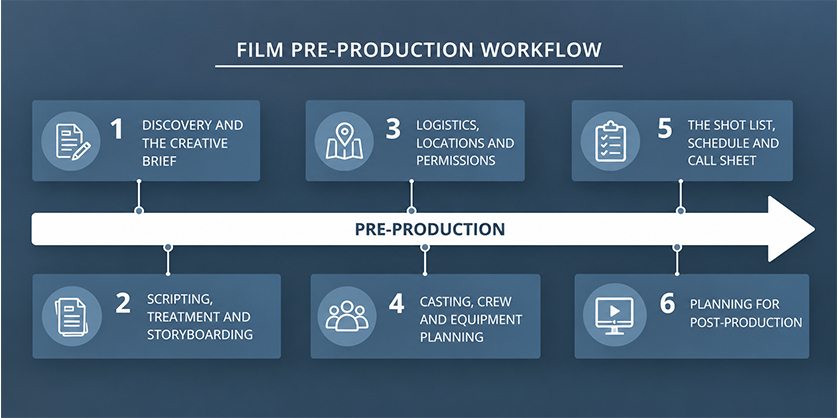
Why Pre-Production Decides the Final Result
The video production planning process begins long before the camera starts rolling.
Pre-production turns a creative idea into a practical production plan. This is where the team defines the objective, audience, visual approach, schedule, equipment, locations and deliverables.
A weak plan can result in overtime, missing footage, continuity problems and costly reshoots. A strong plan gives each crew member, camera setup and lighting decision a clear purpose.
Pakistan also brings practical production challenges. Karachi shoots may involve heavy traffic, changing daylight, coastal humidity, ambient noise and power-related issues. Outdoor productions may require contingency planning for weather and location conditions.
Example: If corporate event videography is being shot inside a Karachi manufacturing facility, the production team needs to consider machinery noise before scheduling interviews. Recording an executive interview beside running industrial equipment can create unusable audio, even when the video looks excellent.

Stage 1: Discovery and the Creative Brief
Defining the Objective
Every project starts with questions, not cameras:
- Who is the target audience?
- Where will the video run: TV, YouTube, Instagram Reels or a corporate presentation?
- What should the viewer understand or do after watching it?
- What deliverables and aspect ratios are required?
The answers become the creative brief, which guides the rest of the production.
Platform-Specific Planning
A Digital Video Commercial (DVC) created primarily for Instagram may require a 9:16 vertical composition, while a corporate film for a website or conference will typically use 16:9.
This decision affects framing, camera positioning, safe areas for text, graphics placement and sometimes even the lens selection.
Example: A telecom or fintech brand launching a Ramadan campaign needs a different visual tone and cultural approach from a year-round product explainer. Establishing that direction during briefing prevents expensive creative changes later.

Stage 2: Scripting, Treatment and Storyboarding
The Script and Treatment
The script establishes dialogue, voice-over, scene structure and key messages. A creative treatment then explains how those ideas will appear on screen, including visual references, mood, colour palette, camera movement and storytelling style.
Language is also part of production planning. Pakistani campaigns may require Urdu, English, Sindhi, Punjabi or bilingual communication. The language and delivery style should match the intended audience.
For example, an Urdu voice-over for a healthcare awareness film will normally require a different tone and vocabulary from an Urdu-English fashion campaign targeting younger consumers.
Storyboards and Animatics
A storyboard provides a visual plan for individual shots. For technically complex productions, an animatic can combine storyboard frames with temporary audio and timing.
This allows the client and production team to review pacing and scene transitions before spending heavily on production.

Stage 3: Logistics, Locations and Permissions
Location Recce
A recce, or location scout, evaluates the practical conditions of a proposed shooting location. The team checks light direction, ambient noise, available power, access, parking, safety, camera positions and crew movement.
A rooftop in Clifton may look ideal during a location visit but become difficult to shoot at midday because of harsh sunlight, wind or surrounding noise.
Permissions and Compliance
Professional producers also address permissions and releases before the shoot:
- Location permissions and property releases
- Talent releases for actors, models and contributors
- Drone permissions and applicable aviation requirements
- Brand and copyright clearances where required
- Broadcast and platform-specific requirements
Drone operations in Pakistan are subject to applicable aviation rules and permissions, so aerial filming should be planned rather than treated as an on-the-day addition.
For television advertising, productions must also account for applicable broadcaster and regulatory requirements.
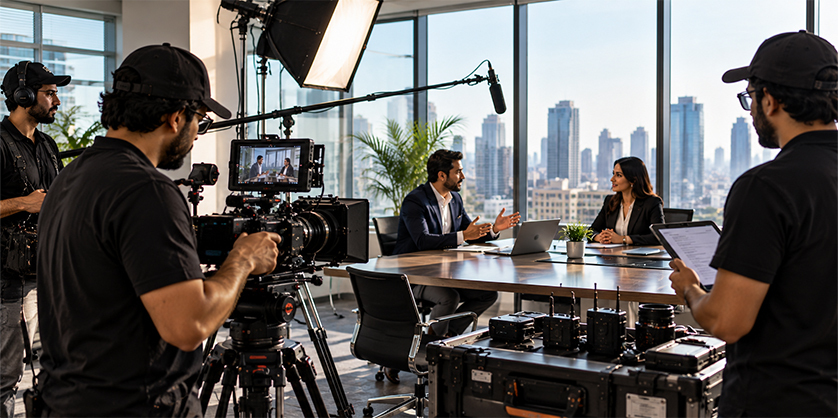
Stage 4: Casting, Crew and Equipment Planning
Building the Right Team
The production crew depends on the project’s scale, but a professional setup may include:
- Director: Responsible for the creative direction and performance
- Director of Photography (DOP): Designs the camera and lighting approach
- Gaffer and grip team: Handles lighting equipment, rigging and practical setups
- Sound recordist: Captures clean production audio
- Production designer or stylist: Manages sets, props, wardrobe and visual details
- Producer / production manager: Coordinates logistics, schedule and budget
Technical Kit Decisions
A professional video production company selects equipment according to the production requirements rather than simply using the most expensive camera available.
Depending on the project, the setup may include cinema cameras capable of 4K or higher resolution, high-bit-depth recording formats, prime or zoom lenses, gimbals, sliders, jibs, LED lighting, diffusion, wireless lavalier microphones and shotgun microphones.
The DOP may also select a suitable picture profile or colour workflow based on the intended post-production process. Log or RAW acquisition can provide greater flexibility for grading when the production and post-production workflow support it.
Example: A Karachi outdoor shoot may require battery backups, additional lighting control and equipment protection because heat, humidity and unpredictable power conditions can affect both crew and equipment.
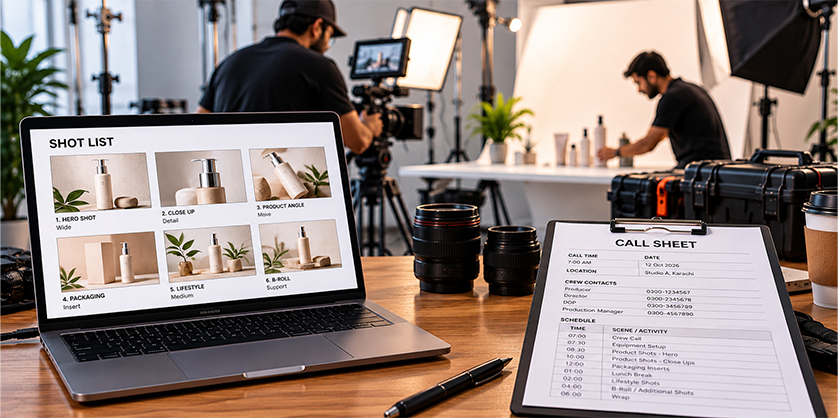
Stage 5: The Shot List, Schedule and Call Sheet
Shot List
A shot list breaks scenes into individual camera setups. It can specify the shot size, camera angle, lens, movement, subject and required action.
For example, a product shoot may require a hero shot, close-up product details, packaging inserts, lifestyle footage and supporting B-roll.
Without a shot list, a production can finish the day with attractive footage but still miss a critical shot required for the final edit.
Call Sheet
The call sheet communicates practical information to the crew and talent, including call times, locations, contact information, scene requirements, weather information, equipment notes and safety instructions.
For multi-location shoots in Karachi, scheduling travel time between locations is particularly important. Traffic can turn a short transfer into a major production delay.
Product Shoots
Product photography and video require their own preparation. The team may plan surface preparation, reflection control, lighting ratios, colour accuracy, background treatment and product positioning.
A stainless-steel cookware product, for example, requires careful control of reflections, while a skincare bottle may need softer lighting to show packaging details without creating distracting highlights.
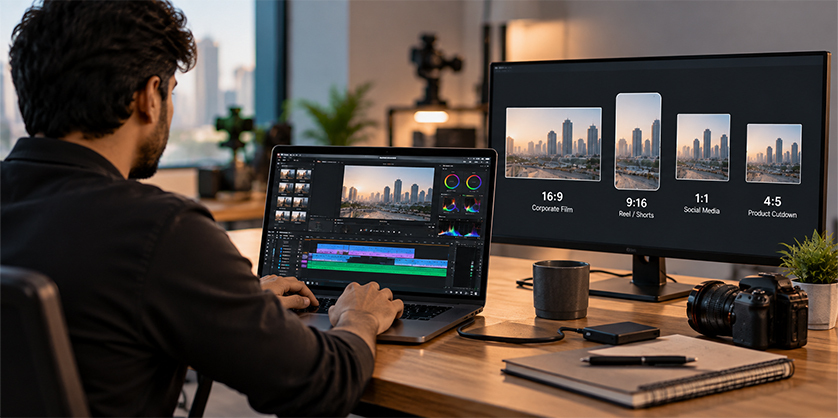
Stage 6: Planning for Post-Production
Professional teams consider the edit before shooting begins. This is an important part of the video production stages, because decisions made during pre-production and filming can directly affect the editing process and final deliverables.
This includes:
- Selecting a colour workflow and appropriate LUTs where required
- Choosing frame rates such as 24 fps for standard cinematic delivery or higher frame rates for planned slow-motion sequences
- Allowing composition space for motion graphics, titles and 2D/3D animation
- Establishing file naming, media management and backup procedures
- Planning music, voice-over and sound design
This is especially important when one production will generate multiple deliverables. A Pakistani brand might need a 16:9 corporate film, a 9:16 Reel, a shorter YouTube version and several product cutdowns from the same shoot.
Planning these versions before filming helps the crew capture footage that can actually be reused across formats.
Questions to Ask Before Hiring a Production House
Before selecting a production company, ask:
- Will you receive a written creative brief and treatment?
- Will the team provide a storyboard or visual shot plan when required?
- Who handles locations, permissions and talent releases?
- What camera, lens, lighting and audio equipment will be used?
- What are the revision rounds and final delivery formats?
- Can the production house show relevant previous work and case studies?
Clear answers to these questions can tell you a lot about how professionally a production will be managed.
Talking About Case Studies? Let’s Look at Artxfilms
The best way to understand professional video production is to look at how real projects are planned and executed. Artxfilms’ case studies provide practical examples of how pre-production, technical planning, on-site coordination and post-production come together on complex projects.
1. Corporate Safety Video for Coats Pakistan
For Coats Pakistan, Artxfilms produced corporate safety induction videos for its Karachi and Lahore divisions. The project required more than filming a factory. The production team had to understand the facility layout, operational areas, safety procedures and department-specific risks before planning the visual narrative.
The commercial video production covered areas including the Dye House, Grey Thread Store, Finishing, Quality Assurance, Warehouse, Engineering Facility, Boiler House, Reverse Osmosis Plant and Waste Treatment Plant. The safety induction also covered PPE requirements, emergency response procedures, fire safety systems, forklift movement, visitor guidelines and workplace behaviour.
The project is a good example of why pre-production matters in industrial filmmaking. The crew had to work inside a live manufacturing environment without disrupting operations while capturing footage that was clear enough for visitors and employees to understand.
Read the full Coats Pakistan corporate video case study.
2. Video Production for Synergy Corporation
ArtX Films provided video production services for Synergy Corporation, covering corporate video production, industrial photography, exhibition coverage and aerial filming.
The production required coverage of technical manufacturing processes including CNC fabrication, control panel assembly, generator and canopy production, and Factory Acceptance Testing (FAT). The team also captured Synergy’s solar installations at SOS Village and Dar-ul-Sukoon using aerial footage.
One of the more practical production challenges came when the client requested additional coverage of the Jamshoro project during the Karachi shoot. Rather than abandoning the existing schedule, the production team divided into two units so filming could continue in Karachi while another team travelled to Jamshoro.
It is a useful example of why production teams need contingency planning and experienced on-ground coordination. A shooting schedule can change quickly, particularly when multiple locations and daylight-dependent footage are involved.
Read the full Synergy Corporation video production case study.
3. Allied Cables Corporate Video
For Allied Cables, the challenge was to communicate a highly technical manufacturing process in a way that remained visually engaging.
The production covered multiple industrial locations, including City Office, HUB and SITE Area, with footage of processes such as copper melting, wire drawing, insulation and quality testing. Executive interviews were also incorporated to connect the manufacturing process with the company’s wider story.
The project reportedly took 40 working days from script development and site planning through post-production and delivery. Working around furnaces, heavy machinery, heat and industrial noise required careful coordination between the production team and factory operations.
The project also demonstrates an important aspect of professional video production: the work does not necessarily end when filming finishes. During post-production, the creative direction was revised, requiring the team to restructure the narrative and adapt the existing footage rather than simply starting again.
Read the full Allied Cables corporate video case study.

Let’s Plan Your Next Video Project
At Artxfilms, we are a professional video production company offering corporate videos, digital video commercials, TV commercials, explainer videos, aerial video, video animation, AI video production and product photography.
With 14+ years of experience, we work with organizations across sectors including technology, finance, education, and healthcare. We also offer a photography studio for rent in Karachi for controlled studio-based productions.
From industrial safety films and manufacturing stories to corporate campaigns and aerial productions, our case studies show how professional video can turn complex business operations into clear, purposeful visual stories.
Looking for professional video production for your company? We can help you plan, produce and deliver content around your business goals.
Frequently Asked Questions
1. What is pre-production in video production?
Pre-production is the planning stage covering the brief, script, locations, crew, equipment, schedule and deliverables.
2. What types of videos does Artxfilms produce?
Artxfilms produces corporate videos, DVCs, TV commercials, explainer videos, aerial videos, animations and AI videos.
3. Does Artxfilms offer product photography?
Yes. Artxfilms provides product photography and studio-based production services.
4. Does Artxfilms provide aerial video production?
Yes. Aerial filming is part of its video production services and requires proper planning and permissions.
5. What should I prepare before a video shoot?
You should define the audience, objective, platform, deliverables and required aspect ratios.
6. Can Artxfilms handle industrial video production?
Yes. Its case studies include manufacturing, safety induction and industrial production projects.